How Agentforce Multi-Agent System Works
Agentforce is one of the best chatbots that is being used widely in organizations. Well, its role has changed from a single chatbot on a website to Multi-Agent Orchestration. Salesforce has built a system where several AI agents work together and hand off tasks to each other, while still feeling as one smooth experience to the end user. For anyone working with Salesforce today, understanding this system isn't optional anymore.
This is how it is becoming a basic skill that was known as Flow or Apex. This article mainly focused on how the Agentforce multi-agent system actually works, step by step, and explains why admins, developers, testers, and consultants all need to get familiar with it. If you are looking to become a Salesforce developer, then applying for the Salesforce Testing Course can help in the same.
The Basic Idea Behind Multi-Agent Orchestration
Teams nowadays focus on making the work easier by ignoring build one large agent that try to answer each type of question. Well, teams are focusing on building the several smaller agents, each focused on one job. Here the main agent is called Orchestrator, which remains on the top of all of these and decides of answering the given request.
The person chatting with the system never sees this happening behind the scenes. They get one continuous conversation, even though several pecialised agents might be working on different parts of their request. Anyone learning Salesforce Training in Delhi will come across this orchestrator setup early on, since it's now a core part of how Agentforce solutions get designed.
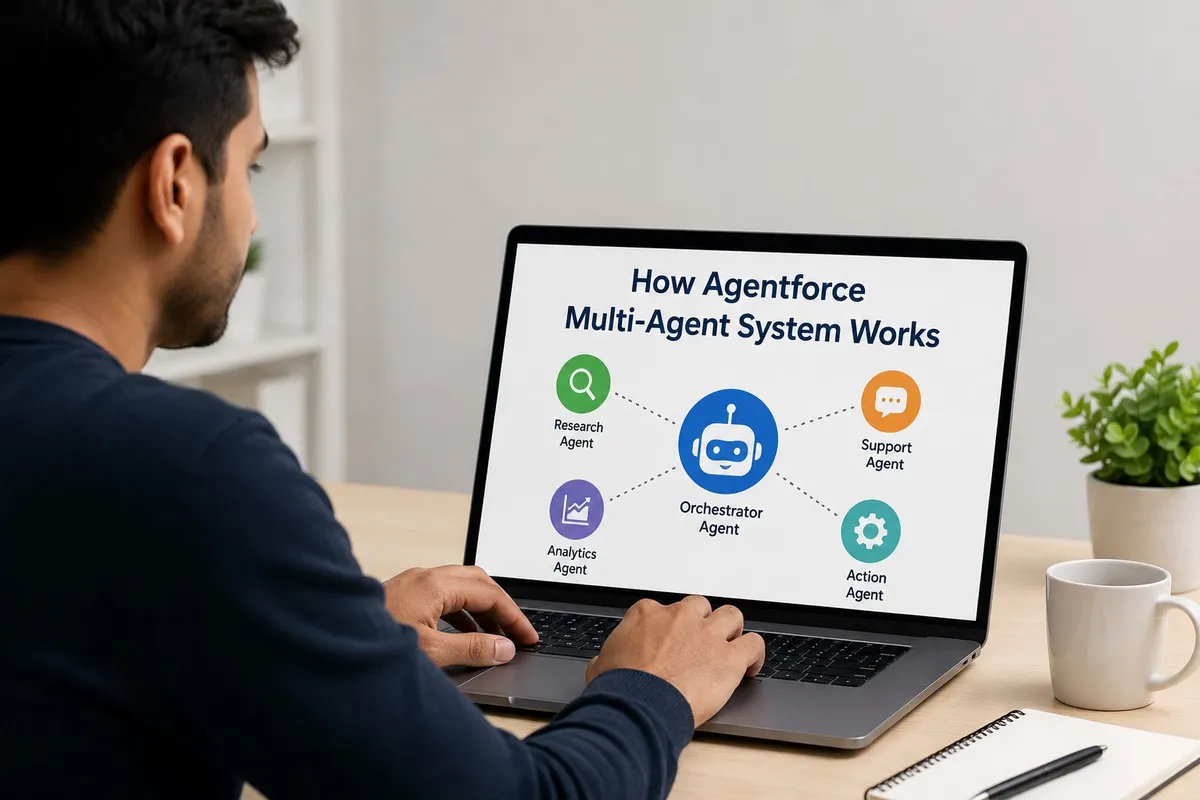
Step-by-step explanation of Understanding How the Agentforce Multi-Agent System Works:
Step 1: Setting Up the Orchestrator and Subagents:
Inside Agentforce Builder, an admin sets one agent as the orchestrator and connects other agents to it as subagents. Each subagent comes with a written description explaining what it does and when it should be used. This description matters a lot, because the orchestrator uses it to decide which agent fits a given task. A vague or poorly written description leads to wrong routing, even if the underlying agent works perfectly fine.
Step 2: Understanding the Request:
When you get a request, the system may read what the person actually needs, not just the exact words they have typed. It checks what information is needed, what action needs to happen, and which connected agent or tool is best placed to handle it.
Step 3: Breaking Down and Routing the Task:
Well, if the request includes more than one kind of work, then the orchestrator will divide it into smaller parts and then send each part to the right agent. Also, the separate results come back and get combined into a single, clear answer for the person who asked.
Step 4: Keeping Context Across Handoffs:
One of the biggest problems in earlier multi-agent setups was losing context between handoffs. Information would get dropped midway, and the next agent would end up missing key details from earlier in the conversation. Agentforce's orchestration layer carries the full background of the conversation along with each handoff, so the next agent already knows what's been discussed.
Step 5: Working With Tools and Other Platforms:
Agents aren't limited to working only with other Salesforce-built agents. By using the Agent2Agent protocol, an Agentforce orchestrator can also coordinate with agents built on completely different platforms. Also, when it gets integrated with the built-in support for connecting outside the vendor's ecosystem, it means the orchestration won’t get locked inside the vendor’s ecosystem. It can stretch across an organisation's entire tech stack.
Why Every Salesforce Professional Needs to Understand This
This isn't just a feature for architects to worry about. It touches almost every role in the Salesforce ecosystem.
Admins need to write clear agent descriptions and structure CRM data well, since poor data quality directly leads to poor routing decisions. Developers need to understand how agents call tools and external systems, since a lot of orchestration depends on integrations working correctly behind the scenes. Consultants need to be able to design which agents a client actually needs, instead of building one bloated agent that tries to do everything.
Testing is where things get especially important. Multi-agent systems fail in ways that are harder to spot than a simple workflow rule breaking. A wrong handoff, a missing piece of context, or a misrouted request can quietly produce a wrong answer without throwing an obvious error. This is exactly why a proper Salesforce Testing Course matters right now. Learning how to test agent descriptions, check routing accuracy, and confirm that context survives a handoff is becoming a real, distinct skill, not something general QA training already covers well.
Getting the Right Training Now Pays Off Later
Because this shift is happening fast, waiting too long to learn it means catching up later under pressure. A solid SFDC Online Training program that includes Agentforce and orchestration concepts gives professionals a way to learn this at their own pace, with proper guidance, instead of piecing it together from scattered release notes and trial and error on a live project.
Conclusion:
The Agentforce multi-agent system is a genuine shift in how Salesforce solutions get designed and delivered. It's not a small UI update or a one-off feature toggle. It changes how agents are planned, how data needs to be structured, and how testing needs to be approached. Professionals who take the time now to understand orchestration, whether through structured SFDC Online Training, will be far better positioned than those who wait until every client project assumes this knowledge as a given.